Featured Industrial Pallet Racking & Warehouse Systems
Precision-engineered cold-rolled steel racking engineered for heavy-duty structural stability, high SKU capacity, and continuous intralogistics performance.
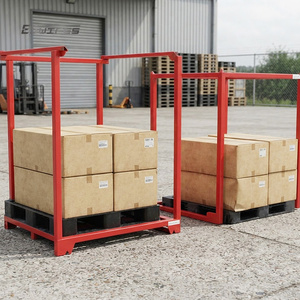
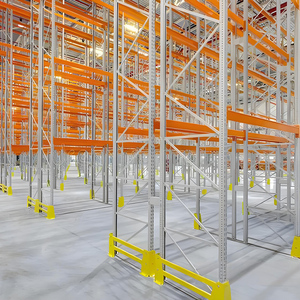
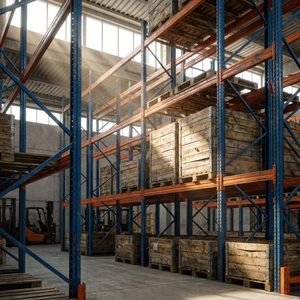
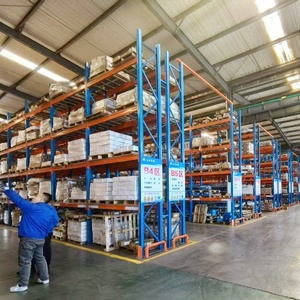
Why Direct Sourcing from Our CE Certified Racking Factory Matters
With a 30,000 m² state-of-the-art production hub and fully integrated engineering workflows, we eliminate intermediary markups while upholding global structural safety norms.
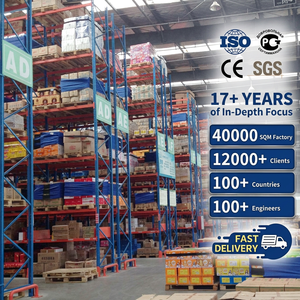
30,000 m² Automated Hub
High-speed continuous cold-roll forming, robotic continuous seam welding, and automated epoxy powder coating lines guarantee batch consistency.
CE & EN 15512 Certified
Racking systems undergo rigorous Finite Element Analysis (FEA) testing in accordance with European FEM 10.2.02 and EN 15512 standards.
Free 24h CAD & 3D Planning
Certified engineering specialists deliver full spatial optimization, seismic safety analysis, and 3D layout simulation within 24 hours.
Rapid 15–20 Day Production
Standard selective pallet racking and boltless longspan shelving produced under lean manufacturing schedules for expedited worldwide logistics.
Structural Engineering, Compliance & Material Dynamics of Heavy-Duty Pallet Racking
In modern industrial logistics, selecting a warehouse racking system requires far more than comparing surface-level dimensions and initial quotes. Structural safety, dynamic yield capacity, seismic performance, and compliance with strict international codes determine the multi-decade operational viability of a distribution center. As a premier **CE Certified Pallet Warehouse Racking Factory and Direct Supplier**, we engineer our storage configurations to resolve complex volumetric challenges while maintaining uncompromising structural safety parameters.
Core Structural Fact: A standard 3-tier selective racking bay holding 3,000 kg per beam level supports a cumulative static frame load exceeding 18,000 kg. Micro-deflections, residual welding stress, and poor alloy selection can drastically lower buckling resistance under concentrated loading. Our factory utilizes high-tensile Q235B and Q355B cold-rolled structural steel to prevent inelastic deformation under full serviceability limit states (SLS).
1. Metallurgical Standards & Mechanical Integrity
The foundation of certified heavy-duty warehouse racking lies in the metallurgical quality of cold-rolled steel coils. Unlike low-tier suppliers using unverified commercial steel, our production facilities process structural-grade steel under strict Quality Management Systems certified to ISO 9001:2015. Uprights are cold-formed into multifold structural profiles (up to 13 distinct bends across the cross-section), exponentially boosting the moment of inertia and torsional stiffness without adding dead weight.
- Q235B vs. Q355B Tensile Dynamics: While Q235B steel offers superior cost-to-performance for standard static racking, Q355B high-strength alloy is utilized for high-bay uprights, narrow-aisle (VNA) systems, and heavy-duty box beams to resist dynamic impact forces from material handling equipment (MHE).
- Automated Continuous Seam Welding: Upright baseplates and beam connector claws are joined using robotic MIG/MAG welding lines certified under ISO 3834-2. This eliminates human error, porosity, and incomplete penetration vulnerabilities.
- Epoxy Polyester Powder Coating: Components undergo an intensive 7-stage surface pre-treatment (including degreasing, zinc phosphating, and electro-static spraying) cured at 200°C. This delivers a resilient coating resisting corrosion, chemical exposure, abrasion, and flaking in ambient and cold-storage (-30°C) environments.
2. European Compliance Framework: CE, EN 15512 & FEM Standards
European and international buyer specifications demand full compliance with European Committee for Standardization (CEN) norms. CE certification for warehouse racking validates that the manufacturing process adheres to strict structural calculation standards and Factory Production Control (FPC).
| Standard Code | Focus Area | Technical Implication for Warehouse Procurement |
|---|---|---|
| DIN EN 15512 | Structural Design of Adjustable Pallet Racking | Mandates limit state design principles, finite element verification, and global frame stability testing under eccentric loading. |
| DIN EN 15620 | Tolerances, Deformations & Clearances | Establishes allowable beam deflection limits (maximum L/200) and operational clearances for reach trucks and automated cranes. |
| DIN EN 15635 | Application & Maintenance of Storage Equipment | Defines legal responsibility for annual racking inspections (DGUV Regel 108-007) and structural safety sign posting. |
| FEM 10.2.02 | Design of Racking & Shelving Systems | Provides empirical formula frameworks for load distribution, sway analysis, and seismic coefficient calculations. |
3. Comprehensive Structural Layout Classification
Different warehouse operational profiles demand distinct racking configurations to balance density, direct accessibility, and throughput speed:
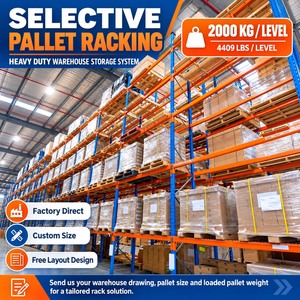
- Selective Pallet Racking: Provides 100% direct pallet accessibility to every SKU. Ideal for distribution centers handling high-mix, low-volume inventory requiring immediate picking flexibility. Beam heights are fully adjustable on 50mm, 52mm, or 75mm pitch increments.
- Double-Deep Pallet Racking: Configured back-to-back using specialized double-reach forklifts. Increases pallet storage density by up to 30% compared to standard selective racking by reducing aisle count.
- Drive-In & Drive-Through Racking: Operates on First-In, Last-Out (FILO) or First-In, First-Out (FIFO) principles. Forklifts drive directly into continuous racking lanes to drop off or retrieve pallets resting on continuous support rails. Perfect for bulk storage of homogeneous goods and cold-room storage.
- Radio Shuttle Automation Racking: Combines heavy-duty racking channels with semi-automated battery-powered shuttles. Shuttles navigate beneath pallet lanes via remote control or WMS interface, maximizing density while protecting upright frames from forklift collisions.
- Very Narrow Aisle (VNA) Systems: Shrinks aisle widths to as low as 1.6 meters, utilizing turret trucks or wire-guided MHE. Increases vertical space utilization up to 15 meters while preserving 100% SKU selectivity.
Future Procurement Trends in Industrial Pallet Racking
Global supply chain evolution, nearshoring strategies, and shifting financial models are reshaping how enterprise buyers specify, contract, and deploy racking assets.
Total Cost of Ownership (TCO) vs. Initial CapEx Sourcing
Modern procurement directors no longer select racking purely on upfront material pricing. Analysis of lifelong maintenance costs under EN 15635 inspections has elevated the importance of heavy-duty column protectors, impact-resistant beam connectors, and factory-certified powder coatings that lower replacement cycles over 15+ years.
Nearshoring & Agile Modular Expansion Contracts
Global supply chain volatility has accelerated nearshoring and regional buffer warehousing. Buyers are prioritizing OEM manufacturers offering modular, boltless, re-configurable racking frames that enable quick physical re-layout without requiring structural scrapping or structural re-welding.
Decarbonization & Green Steel Certification Compliance
As Scope 3 carbon emissions monitoring becomes mandatory for multinational enterprises, procurement teams require raw material origin verification. Our factory integrates low-emission EAF (Electric Arc Furnace) recycled steel options and ultra-low VOC electrostatic powder processes to help clients meet corporate ESG targets.
Future Development Trends of Warehouse Racking Systems
Hardware racking structures are rapidly intersecting with automation, robotics, IoT structural health sensors, and AI-driven warehouse execution software.
Seamless AMR/AGV Robotics & High-Tolerance Beam Engineering
Autonomous Mobile Robots (AMR) and Automated Guided Vehicles (AGV) demand significantly tighter deflection tolerances than traditional manual forklifts. Future racking systems are manufactured with millimeter-precise laser cutting and automated punch tooling to prevent floor-level or beam-level robot sensor misalignments.
IoT Smart Racking & Real-Time Structural Strain Monitoring
The integration of optical and strain-gauge sensors into critical load-bearing uprights is becoming standard for high-bay facilities. Smart racking alerts operations teams in real-time when structural impact occurs or when safe load capacity thresholds are exceeded, preventing catastrophic collapse events.
Dynamic Seismic Engineering & High-Zone Structural Resiliency
With warehouse footprints expanding into seismically active zones across Europe, the Americas, and Asia-Pacific, racking development focuses on non-linear dynamic simulation (FEM 10.2.08 & RMI standardizations). Specialized baseplate dampers and engineered cross-bracing absorb ground motion shockwaves.
Frequently Asked Questions (FAQ) for Pallet Racking Procurement
Direct technical answers to common questions asked by project engineers, safety managers, and procurement officers.
Optimize Your Warehouse Capacity with CE Certified Racking
Connect directly with our senior structural engineering team. Receive a free layout evaluation, FEA load calculations, and competitive factory-direct pricing within 24 hours.
Get a Quote