Engineering Whitepaper: Heavy-Duty Industrial Pallet Racking Selection & Procurement Benchmark
Modern warehouse intralogistics requires a sophisticated alignment of structural engineering, metallurgical performance, spatial optimization, and material handling efficiency. Selecting the best industrial pallet racking suppliers in China is no longer merely a pricing comparison; it is a complex structural decision that affects operational safety, long-term maintenance costs, throughput rate, and scalability.
1. Structural Metallurgy & Materials Engineering: Q235B vs. Q355B Steel
The core load-bearing capability of industrial pallet racking relies entirely on the structural steel profile quality. Leading Chinese industrial racking manufacturers utilize continuous cold-roll forming lines using high-grade structural steel coil. Understanding the material properties is essential for procurement managers during RFP evaluations:
- Q235B Steel: The standard industry structural carbon steel offering a yield strength (fy) of 235 MPa and ultimate tensile strength ranging between 375–500 MPa. Highly ductile, ideal for standard ambient warehouse storage applications up to medium-high load thresholds.
- Q355B Steel (High-Yield Alloy): Superior high-tensile structural steel with a yield strength of 355 MPa. Used extensively in high-bay vertical racking (exceeding 10 meters height), heavy-duty seismic zone installations, and automated high-density shuttle storage systems to minimize frame deadweight while enhancing load capacity.
Our automated manufacturing lines feature precision roll-forming machines capable of punching upright profiles with exact 50mm or 75mm beam adjustment pitches, offering strict dimensional tolerances compliant with EN 15620 standards.
2. Technical Comparison Matrix of Heavy-Duty Storage Configurations
To help warehouse logistics engineers select the precise racking architecture, the table below provides a detailed structural comparison across primary racking topologies manufactured in China:
| Racking Architecture | Direct Selectivity | Floor Area Utilization | Stock Rotation Method | Forklift Aisle Requirement | Ideal Application Scenario |
|---|---|---|---|---|---|
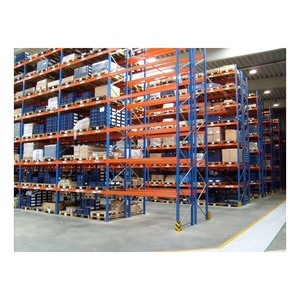
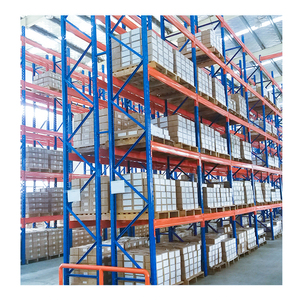
| Selective Pallet Racking | 100% Direct Access | ~40% - 45% | FIFO (First-In, First-Out) | Standard Aisle (3.0m - 3.8m) | High SKU counts, fast-moving consumer goods (FMCG), general distribution centers. |
| Double-Deep Selective | 50% Direct Access | ~55% - 60% | LIFO (Last-In, First-Out) | Specialized Deep Reach Truck | Identical SKU batching, high-density storage with moderate selectivity needs. |
| Drive-In / Drive-Thru Racking | Low (Lane Selective) | ~65% - 75% | LIFO / FIFO (Drive-Thru) | Internal Lane Driving Required | Cold storage, seasonal inventory, bulk homogeneous goods. |
| Radio Shuttle Automated Racking | High (Lane Level) | ~75% - 85% | Programmed FIFO & LIFO | Standard Outer Loading Aisle | Automated cold rooms (-25°C), high-throughput food & beverage logistics. |
| Very Narrow Aisle (VNA) | 100% Direct Access | ~60% - 70% | FIFO (First-In, First-Out) | Ultra-Narrow (1.5m - 1.8m) | High-bay warehouses with restricted footprint where high vertical space is available. |
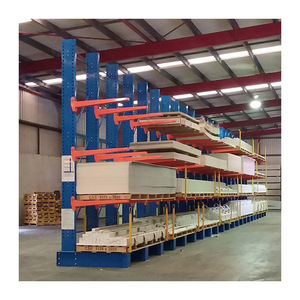
| Industrial Cantilever Racking | 100% Open Access | Variable / Custom | Flexible Handing | Side-Loader / Standard Truck | Long, continuous loads such as steel pipes, timber, metal profiles, and PVC tubes. |
3. Global Structural Engineering Standards & Compliance Verification
Safety is the foundational imperative in warehouse management. Premium China industrial pallet racking suppliers engineer systems that conform to international safety regulations to protect workers and inventory assets:
- FEM 10.2.02 (European Federation of Materials Handling): Governs the design of static steel pallet racking systems, dictating load combination formulas, column buckling calculations, and beam connector safety pin displacement thresholds.
- DIN EN 15512: Specifies structural design requirements for adjustable pallet racking, factoring in dynamic horizontal sway forces, floor slab tolerances, and accidental collision impact allowances.
- ANSI / RMI MH16.1 (USA Standard): Dictates the structural design parameters for industrial steel storage racks used across North American logistics networks.
4. Surface Treatment & Environmental Resilience
To resist industrial abrasion, chemical exposure, and humidity, structural racking components undergo a rigorous multi-stage surface preparation process:
1. Chemical Degreasing & Acid Pickling: Eliminates surface scale, rust, and residual mill oils.
2. Zinc Phosphating Pre-treatment: Enhances anti-corrosion barrier bonding.
3. Electrostatic Epoxy Powder Coating: Applied at 60–80 microns thickness and baked in a 200°C curing oven to deliver a high-durability, impact-resistant finish.
4. Hot-Dip Galvanizing (HDG): Recommended for harsh outdoor, chemical exposure, or sub-zero freezing environments (-30°C cold storage), applying a zinc layer exceeding 65–85 microns for multi-decade rust prevention.