Industrial Racking & Storage Systems Portfolio
Certified Q235B & Q355B heavy-duty structural steel solutions tailored for maximum load capacity, ISO9001 compliance, and optimized floor footprint utilization.
Enterprise Capabilities & Manufacturing Engineering Leadership
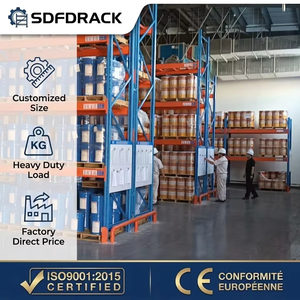
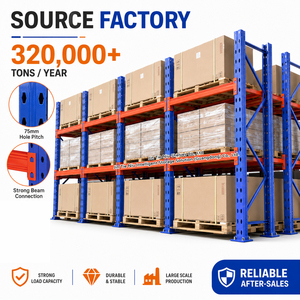
As a top-tier global pallet racking manufacturer, our 30,000 m² state-of-the-art production base integrates automated cold roll-forming lines, robotic welding stations, and electrostatic powder coating technology to deliver high-precision rack structures.
Direct-from-Factory Edge
Eliminate intermediary costs with our integrated supply chain model, accelerating lead times to 15–20 days for standard enterprise projects.
Rapid CAD Layout Design
Our structural engineering team delivers initial 2D floor plans and 3D space visualization models within 24 hours of brief reception.
Strict Standards Compliance
Calculated strictly under FEM 10.2.02, DIN EN 15512, and ANSI/RMI MH16.1 protocols, guaranteeing structural integrity under full load.
Global Turnkey Delivery
Proven track record supplying large logistics hubs across Europe, North America, Australia, and Asia-Pacific with comprehensive documentation.
Comprehensive Engineering Selection & Product Recommendation Matrix
Evaluating Structural Integrity: Structural Steel Selection & Deflection Limits
When procuring heavy-duty industrial storage racks, evaluating raw material composition and section moduli is paramount. Our racking systems utilize prime high-tensile hot-rolled steel coil grades Q235B and Q355B (equivalent to European S235JR and S355JR). The yield strength ratio ($\sigma_y \ge 355\text{ MPa}$) ensures enhanced resistance against accidental forklift impact and flexural buckling.
According to FEM 10.2.02 and European standard DIN EN 15512, horizontal rack beam deflection under full operational load must strictly adhere to the limiting threshold of $L/200$ (where $L$ represents beam clear span). For high-bay operations utilizing Narrow Aisle (VNA) or automated storage systems (AS/RS), tighter tolerances of $L/300$ are systematically integrated into calculations to prevent automated crane sensor trip errors.
System Architecture & Operational Comparison
| Racking Architecture | Pallet Selectivity | Floor Space Utilization | Stock Handling Logic | Ideal Industry Application |
|---|---|---|---|---|
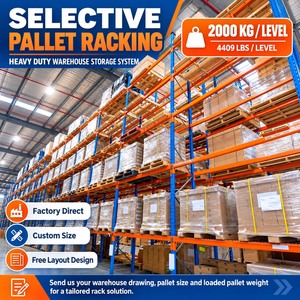
| Selective Pallet Racking | 100% Direct Access | 35% - 40% | FIFO (First-In, First-Out) | FMCG, Multi-SKU Distribution Centers, E-Commerce Logistics |
| Double Deep Racking | 50% Direct Access | 50% - 60% | FILO (First-In, Last-Out) | Cold Storage, Bulk Goods, Batch Chemical Processing |
| Very Narrow Aisle (VNA) | 100% Direct Access | 65% - 75% | FIFO | High-Bay Warehouses with Elevated Vertical Footprint |
| Radio Shuttle Racking | Lane-based Access | 80% - 85% | Configurable FIFO / FILO | Food & Beverage, Frozen Logistics, High-Volume Homogeneous Cargo |
| Drive-In / Drive-Through | Lane-based Access | 70% - 80% | FILO / FIFO | Seasonal Inventory Storage, Beverage Manufacturing |
Future Procurement Trends in Industrial Storage (2025–2030)
Supply chain managers and warehouse operation directors face changing economic realities. Modern procurement strategies are shifting away from baseline price per pallet position toward holistic Total Cost of Ownership (TCO) and intralogistics system integration.
AS/RS & Autonomous Shuttle Integration
Conventional static storage is rapidly integrating with Autonomous Mobile Robots (AMRs) and Radio Shuttle carts. Racking structures must now be engineered with ultra-precise tolerances (±1.5mm tolerance across multi-bay spans) to accommodate high-speed robotic grippers and optical positioning sensors.
Green Steel & Low-Carbon Manufacturing
Global logistics brands require ESG compliance throughout their supply chain. High-efficiency structural steel roll-forming process using recycled scrap steel with zero-VOC epoxy powder coatings provides measurable carbon reduction points for LEED-certified facilities.
High-Density Cold Storage Optimization
With global temperature-controlled logistics expanding, energy costs per cubic meter of frozen space are escalating. High-density shuttle and mobile rack solutions increase thermal density, reducing energy consumption per pallet position by up to 35%.
Technological Innovation & Development Trends
1. Modular Boltless Lock-Beam Connections
Traditional structural bolted systems are increasingly replaced by cold-formed 5-hook connector brackets with automatic self-locking safety pins. This mechanical design decreases installation labor hours by 40% while preventing beam dislodgement under upward forklift loading vectors.
2. IoT-Enabled Structural Health & Strain Monitoring
Modern warehouse installations incorporate dynamic load sensors and IoT strain gauges within critical frame uprights. Real-time telemetry alerts maintenance engineering teams if structural overload thresholds or physical forklift collision impacts degrade structural safety factors.
3. Advanced Anti-Corrosion Surface Coatings
For humid chemical environments and blast-freezer operations (-30°C), thermal diffusion galvanizing (TDG) and high-durability polyester powder coating formulations prevent micro-cracking, hydrogen embrittlement, and oxidation creep over multi-decade operational lifecycles.
Frequently Asked Questions (FAQ) for Global Buyers
Detailed technical and commercial answers addressing critical compliance, engineering, and procurement considerations.
Which structural engineering codes govern your rack design calculations?
Our pallet racking systems are engineered compliant with European FEM 10.2.02 and DIN EN 15512 design specifications. For projects bound for the Americas, calculations follow ANSI/RMI MH16.1 specifications, while Australian projects are certified to AS4084-2012 standards. Comprehensive FEA (Finite Element Analysis) stress distribution reports can be provided upon request during project engineering sign-off.
What are the lead times for custom high-bay rack manufacturing and shipping?
Standard selective pallet racking orders enter production immediately after CAD approval, maintaining a standard factory fabrication lead time of 15 to 20 business days. Specialized automated AS/RS or custom multi-tier mezzanine projects typically require 25 to 30 days depending on raw material coil mill production runs and surface coating requirements.
How are floor slab point loading and anchoring capabilities validated?
Upright baseplate dimensioning and wedge anchor specifications ($M10 \times 80\text{mm}$ to $M16 \times 140\text{mm}$) are determined based on concrete floor compressive strength (typically C20/25 to C30/37 rating). Our structural engineering documentation provides exact point load values (in kN) per frame leg to verify your floor slab's punching shear and flexural slab capacity prior to installation.
Are mandatory structural inspections required post-installation?
Yes. According to DIN EN 15635 and DGUV Rule 108-007 (or localized OSHA requirements), rack operators must conduct regular visual safety checks alongside a formal annual inspection performed by a qualified competent person (befähigte Person). We supply load safety plaques, maintenance check logs, and as-built drawings to streamline compliance audit documentation.
Can standard pallet racks accommodate non-standard wood or plastic pallets?
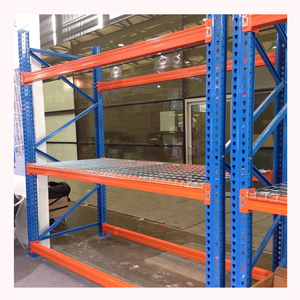
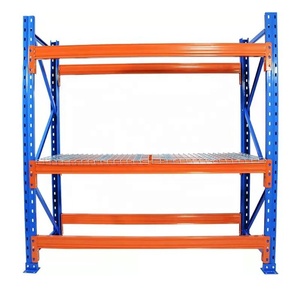
Yes. While standard beam lengths (e.g., 2700mm for 3 standard Euro-pallets or 2300mm for 2 standard US Industrial pallets) assume standard dimensions, non-standard unit loads can be safely stored by integrating pallet support bars, galvanized wire mesh decking, or steel drop-in shelves to ensure uniform load distribution across the rack beams.
Optimize Your Warehouse Footprint Today
Connect directly with our structural racking engineers. Receive custom CAD layouts, structural FEA load calculations, and factory-direct wholesale pricing within 24 hours.
Get Catalog