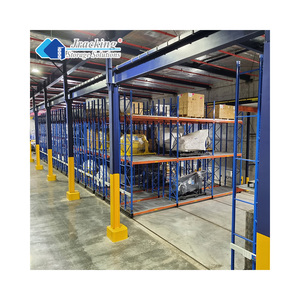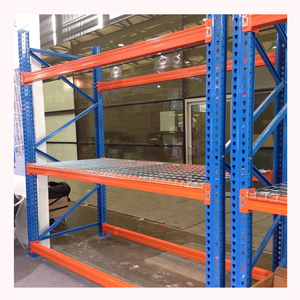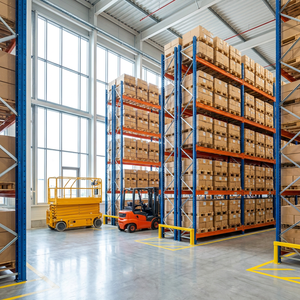
China Wholesale Warehouse Shelving Racks Manufacturer & Suppliers

Engineering-Grade Heavy-Duty Storage Systems, Industrial Pallet Racking & High-Density Automated Shelving Solutions Built for Global Logistics Excellence

Engineered Product Range

High-Performance Industrial Storage Racks & Shelving Systems

Direct-from-factory wholesale manufacturing engineered according to FEM 10.2.02, ISO 9001, and ANSI/RMI industrial standards for maximum structural reliability.

28+
Years Manufacturing Mastery
30,000 m²
State-of-the-Art Factory
FEM & ANSI
Certified Quality Compliance
90+
Global Export Countries
Factory Expertise & Compliance

Why Partner with a Leading Chinese Wholesale Storage Manufacturer?

Direct manufacturing depth, structural engineering excellence, and stringent quality control protocols tailored to international procurement standards.

Advanced Metallurgical Standards

We source certified high-tensile cold-rolled steel (Q235B and Q355B grades) from tier-1 steel mills. Our profiles undergo automated continuous roll-forming to ensure uniform thickness, accurate grain alignment, and superior yield strength ($f_y \ge 355 \text{ MPa}$).

International Structural Compliance

All structural load calculations are performed in accordance with European FEM 10.2.02 (DIN EN 15512), Australian AS4084-2012, and American ANSI/RMI MH16.1 specifications. Complete finite element analysis (FEA) reports are provided for custom warehouse layouts.

Precision Automated Surface Treatment

Components undergo an 8-stage pre-treatment wash including acid pickling, phosphating, and deionized water rinsing, followed by automated electrostatic epoxy powder coating (60–80 μm thickness) providing salt-spray corrosion resistance up to 500 hours.

Engineering Insight: Load Deflection & Structural Safety Factors

In accordance with global industrial racking design codes, beam design strictly adheres to a maximum deflection limit of L/200 under full nominal static load. Upright columns feature safety pins engineered to withstand an upward dislodgement force exceeding 10 kN, preventing accidental beam displacement during high-speed forklift operation.

Procurement Matrix

Comparative Framework for Industrial Warehouse Racks

Match your operational throughput requirements, pallet dimensions, and building geometry with the optimal industrial racking architecture.

Racking Architecture Storage Density Pallet Selectivity Handling Equipment Required Typical Load Capacity Primary Application Context
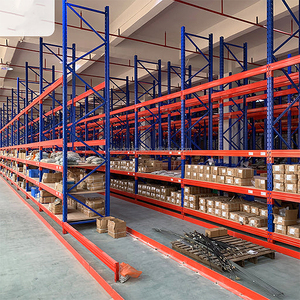
Selective Pallet Racking Standard (40-50%) 100% Direct Access Standard Counterbalance / Reach Truck 1,000 - 4,000 kg / level High-SKU distribution, general FMCG logistics.
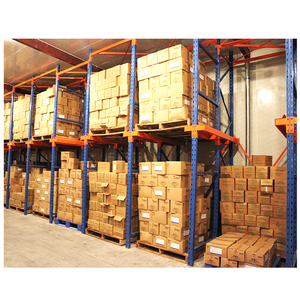
Double Deep Racking High (60-65%) 50% Immediate Access Deep-Reach Pantograph Forklift 1,000 - 3,000 kg / level Multiple pallets per SKU, warehouse expansion.
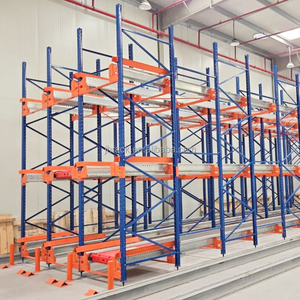
Radio Shuttle Racking Ultra-High (80-85%) Lane-Selective (FIFO/LIFO) Standard Forklift + Automated Shuttle 1,500 kg / pallet unit Cold storage (-30°C), food & beverage, volume SKUs.
Electric Mobile Racking Maximum (85-90%) 100% On-Demand Access Standard Reach Truck Up to 24,000 kg / mobile bay High-cost floor space, pharmaceutical cold stores.
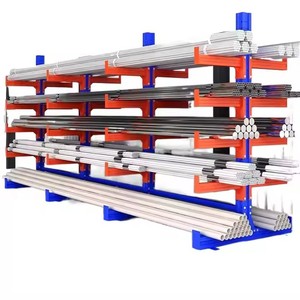
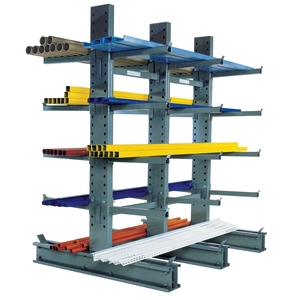
Cantilever Systems Customized Density 100% Longitudinal Access Side Loader / Standard Forklift 500 - 3,000 kg / arm Long items: structural steel, pipes, timber, sheet metal.
Future Outlook

Technical & Market Trends Shaping Industrial Racking

How automation, structural sensor networks, green steel initiatives, and digital twins are redefining modern warehouse infrastructure.

1. Convergence with Automated Guided Vehicles (AGVs) & AS/RS

Modern warehouse shelving is transitioning from static storage into dynamic structural frameworks optimized for robotics. Modern racks feature integrated rack-entry sensors, photoelectric retro-reflectors, and ultra-precise manufacturing tolerances ($\pm 0.5 \text{ mm}$ beam squareness) necessary for seamless integration with Autonomous Mobile Robots (AMRs) and automated stacker cranes.

2. Structural Health Monitoring (SHM) via IoT Sensors

Leading wholesale manufacturers are embedding strain gauges, piezoelectric impact sensors, and tilt indicators into upright column guards. These smart sensors transmit real-time telemetry to the warehouse management system (WMS), alerting safety managers to forklift collisions or over-load stress before catastrophic structural failure occurs.

3. Decarbonization & Green Steel Procurement

Global supply chains demand lower Scope 3 carbon footprints. Chinese manufacturers are pioneering zero-emission manufacturing processes by leveraging Electric Arc Furnace (EAF) recycled green steel, low-VOC powder coatings, and solar-powered cold-roll production facilities to meet strict European ESG targets.

4. Cold Chain Specific Steel Alloys & Surface Finishes

With the exponential growth of fresh food ecommerce and biological cold storage, specialized steel formulations containing nickel-manganese micro-alloys are utilized to maintain ductility and prevent brittle fracture at sub-zero temperatures (down to -30°C).

Strategic Procurement

Best Practices for Sourcing Industrial Shelving from China

A comprehensive guide for B2B buyers, supply chain directors, and logistics engineers navigating large-scale factory procurement.

1. Technical Specification Verification

Always demand mill test certificates (MTC) according to EN 10204 3.1 verifying chemical composition and mechanical properties ($R_e$, $R_m$, and elongation percentage). Do not evaluate suppliers purely on total steel weight; examine section modulus and profile design.

2. Container Loading Optimization

Racking components require customized bundle packing, protective corner guards, and heavy-duty steel strapping to prevent ocean transit damage. Professional China manufacturers utilize 3D software to optimize 40ft High Cube container cube utilization (achieving over 95% volumetric fill).

3. Installation & Supervision Engineering

Ensure your supplier supplies comprehensive installation blueprints, anchor torque specifications, structural tolerance guidelines (ISO 15620), and video assembly walkthroughs. Qualified suppliers provide on-site installation supervision for large-scale projects.

Technical Helpdesk

Frequently Asked Questions by Industrial Sourcing Managers

In-depth engineering answers covering manufacturing lead times, structural compliance, surface finish longevity, and layout customization.

What structural steel grades are utilized in your warehouse racking manufacturing?

Our upright frames and load beams are primary-manufactured from high-yield cold-rolled steel meeting Q235B and Q355B standards (equivalent to European S235JR and S355JR / ASTM A1011 Grade 50). Q355B steel offers superior tensile strength ($f_u \approx 470-630 \text{ MPa}$), allowing thinner profiles to carry higher payloads while lowering gross freight costs.

How do you guarantee racking structural compliance with local building codes?

Every project undergoes computer modeling and structural analysis using certified FEA finite element calculation tools. We design systems according to European FEM 10.2.02 / DIN EN 15512 specifications, American ANSI/RMI MH16.1 codes, and Australian AS4084 standards. Seismic calculations (Zone 1 through 4) and concrete floor slab anchor loading reports are supplied upon request.

What is the standard production lead time for wholesale bulk orders?

Standard pallet racking orders (5 to 15 container loads) have a typical manufacturing lead time of 15 to 20 business days. For customized automated shuttle systems or multi-tier mezzanine projects requiring tailored roll-forming tooling, manufacturing schedules range from 25 to 35 days from final CAD layout approval.

What surface treatment options are available for specialized storage environments?

We provide two primary surface finish options: Thermosetting Epoxy-Polyester Powder Coating (standard for ambient dry warehouses, 60–80 μm thickness) and Hot-Dip Galvanizing (HDG according to ISO 1461, yielding 80–120 μm zinc coating thickness). HDG is strongly recommended for outdoor open-air storage, high-humidity processing plants, and aggressive chemical environments.

Can your engineering team assist with free 2D/3D CAD warehouse layout design?

Yes. Our dedicated structural engineering team provides complimentary 2D CAD architectural placement drawings, 3D BIM visualization models, and storage capacity optimization analysis within 24 hours of receiving your building dimensions, pallet specs, and forklift operation parameters.

What quality assurance inspections are performed prior to container loading?

Our quality control protocol incorporates raw material spectrometer testing, continuous profile dimension checks, weld seam non-destructive inspection (NDT), coating thickness measurement, drop-impact testing, and full structural prototype load testing. Customers receive a detailed pre-shipment inspection (PSI) dossier containing high-resolution dimensional verification photographs.

Transform Your Warehouse Density & Operational Efficiency Today

Connect directly with our engineering team for a free structural CAD layout design, technical load assessment, and direct factory wholesale pricing.

Send an Inquiry